I Built the App I Couldn't Buy
I bought a walking pad so I could move while I work.
Then I learned that walking and getting credit for walking are two different things.
I walked for hours at my desk. Hands on the keyboard, no arm swing, so my Apple Watch counted nothing. The watch is built around one assumption, that walking swings your arms, and my desk broke it. As far as my rings were concerned, those hours never happened.
A hundred dollars of almost
I tried a few paid apps. About $100. None of them reliably put a walk into Apple Health.
Some connected to the pad but kept the data in their own silo. Some synced steps but not workouts. Some needed the phone unlocked and the app open the whole time, which defeats the point of walking while you work.
I wanted my steps in Health and my rings to close. That was the whole brief.
Read that again as a product person. A customer with money, a clear problem, a one-sentence brief, and a hundred dollars already spent trying to give it to someone. Nobody had built it. Not because it was hard, but because it fell between products: the pad maker ships hardware, the app makers ship dashboards, and Apple assumes arms swing.
So I built Waalk
So I built the app I couldn't buy.
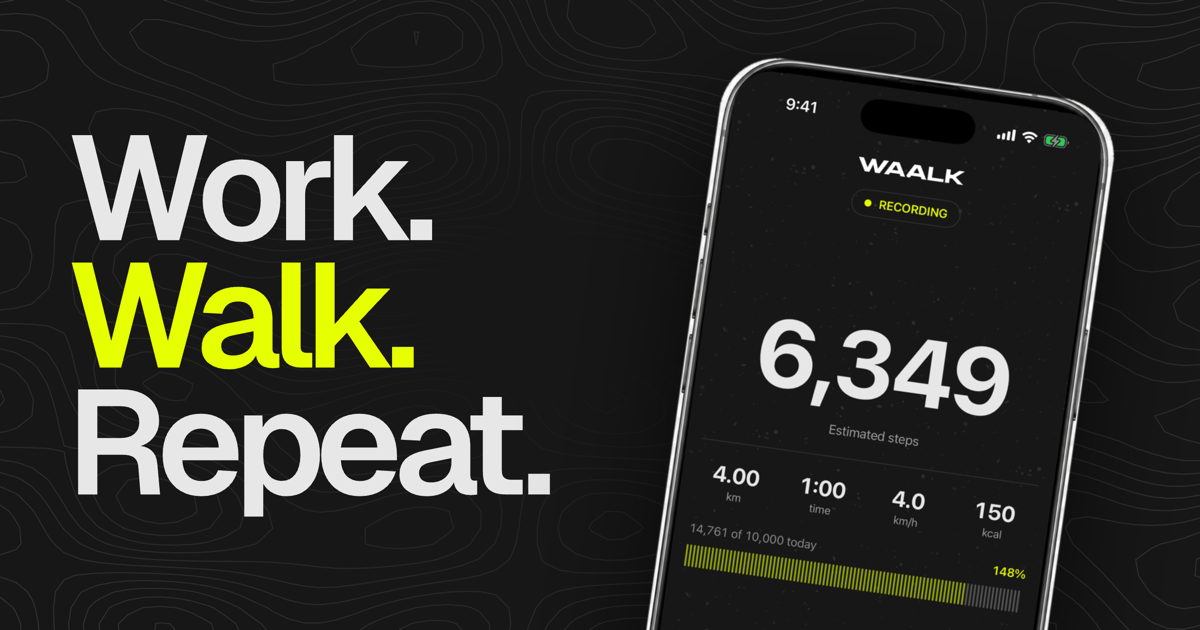
It's called Waalk. It reads distance straight from the pad over Bluetooth and writes the walk to Apple Health while the phone stays locked on the desk.
It also drives the belt. Start, speed, pause, all from the phone or the watch. The ugly plastic remote went in a drawer.
That's the entire product. No feed, no streaks, no social layer, no dashboard asking how my walk made me feel. It does the one job the brief asked for and then gets out of the way. A year ago I'd have written this up as a spec and tried to find a developer. That excuse is dead, and shipping my own app taught me the distance from brief to App Store is now mostly willingness.
The parts were all in the room
Here's what the hundred dollars of failed apps taught me.
Every piece was already in the room. The pad, the watch, the phone, Apple Health. They didn't talk to each other.
The pad had Bluetooth and a documented protocol. Health had an API built for exactly this. The watch could control anything. Four mature products from three companies, sitting on one desk, each doing its own job perfectly and refusing to complete the sentence.
That's the job most products skip. The parts exist. The experience doesn't.
It's the pattern I keep writing about from the client side. The $2.5 trillion AI buildout has the same shape: capability everywhere, experience nowhere. The value isn't in another part. It's in the connective tissue nobody owns, because it doesn't belong to any one company's roadmap.
And it's a neat sequel to the environment argument the walking pad started. The pad put walking in the path of my work. Waalk put the credit in the path of the walking. Both are the same design move: don't change the human, close the gap between things that already exist.
Where it is
Waalk is on the App Store at waalk.app.
It's verified on the TOPUTURE TP7 and TP8, including belt control from the phone and watch. Other FitShow pads (they show up in Bluetooth as FS-, FSGN or TR510-T) use the same protocol and should record, though I haven't tested them on hardware. KingSmith WalkingPads aren't supported.
First 10 walks are free, then AU$14.99 once. No subscription, because a utility that does one job shouldn't rent it to you.
My rings close now. The remote is still in the drawer.
---